
Anyone who has been to India never forgets the experience.
It is an all-consuming overload for every sense. The colours, the smells, the sounds, the traffic, the press of people, the spectacular scenery, the vast and vibrant cities, the poverty, the wealth, the food, the languages: India entrances, spellbinds and challenges in a way few other countries can. As four Wesley students have found out this term.
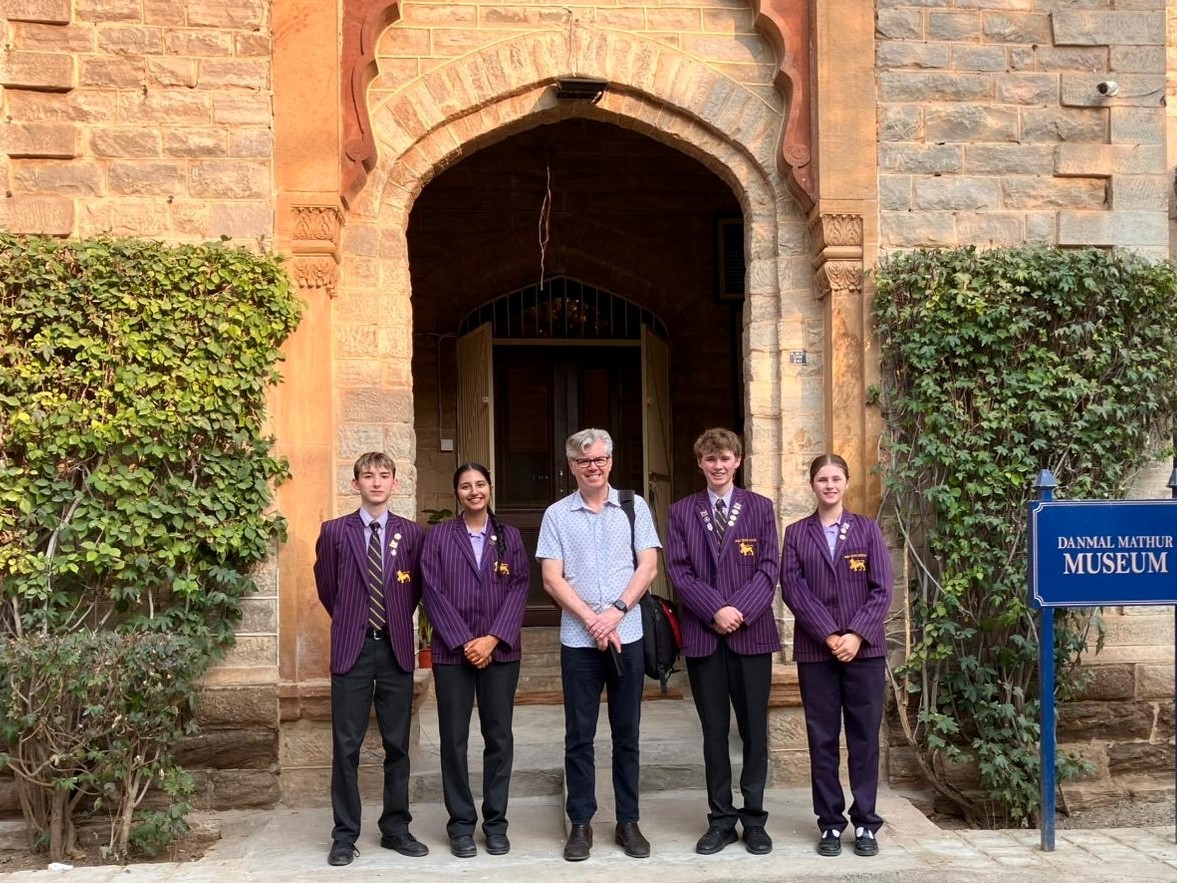
These four students are the inaugural exchange students to Mayo College, Ajmer. Mayo College is one of the oldest and most famous schools in India. It was founded in 1875 by Earl Mayo, then Viceroy of the British Raj. His intent on founding the school was clear; he wanted an ‘Eton of India’. At that time, India was under the direct rule of the British, a period known as the Raj.
Within the Raj, there were a substantial number of smaller states with their own rulers who were given a degree of independence, known as the princely states. Mayo College was founded with the express purpose of educating the scions of these states and those who helped them rule.
The first student at Wesley College was Freddie Binks from Bendigo who turned up with one suitcase a day early and spent the night on his own in a dormitory. The first student at Mayo College was His Highness Maharajah Mangal Singh of Alwar, who arrived on the back of an elephant, with 300 servants and a travelling menagerie of camels, horses and tigers. Mayo has continued to have a very close association with many of the royal families of India and many distinguished Indians have attended the College. In 1987, Mayo College opened Mayo Girls’ School across the road from the boys’ school. Both are fully boarding and have an astonishing array of cocurricular activities.
Wesley was very pleased to welcome our first Mayo exchange students in May this year. Our Mayo students lived in the boarding house at Glen Waverley while here and ticked off many of the activities expected of a visitor to Victoria: the Great Ocean Road, surfing and caving at Lochend, the Healesville Sanctuary and of course, football at the MCG.
The hospitality extended to the Wesley students over past weeks at Mayo has been extraordinary. Each were taken by their Mayo buddies home for Diwali. While their buddies did exams, they were shown many of the sights of the neighbouring states, including of course, the Taj Mahal. They returned to Mayo for classes and to participate in the festivities for the 150th anniversary of Mayo’s founding.
India is more than simply a feast for the senses. It is also the largest democracy in the world and a rapidly growing economy. The relationship between India and Australia will be of essential importance to both countries over the next century. There will be increasing economic, cultural, political, social and sporting ties between the two countries. Wesley will have its first overseas student from India enrolled at the College next year and the children of Indian migrants are already attending the College in ever-increasing numbers.
To have a relationship with a school like Mayo, and in a country of such importance to Australia, is wonderfully exciting.
Nick Evans (OW1985)