Student voices take centre stage at IB world leaders visit
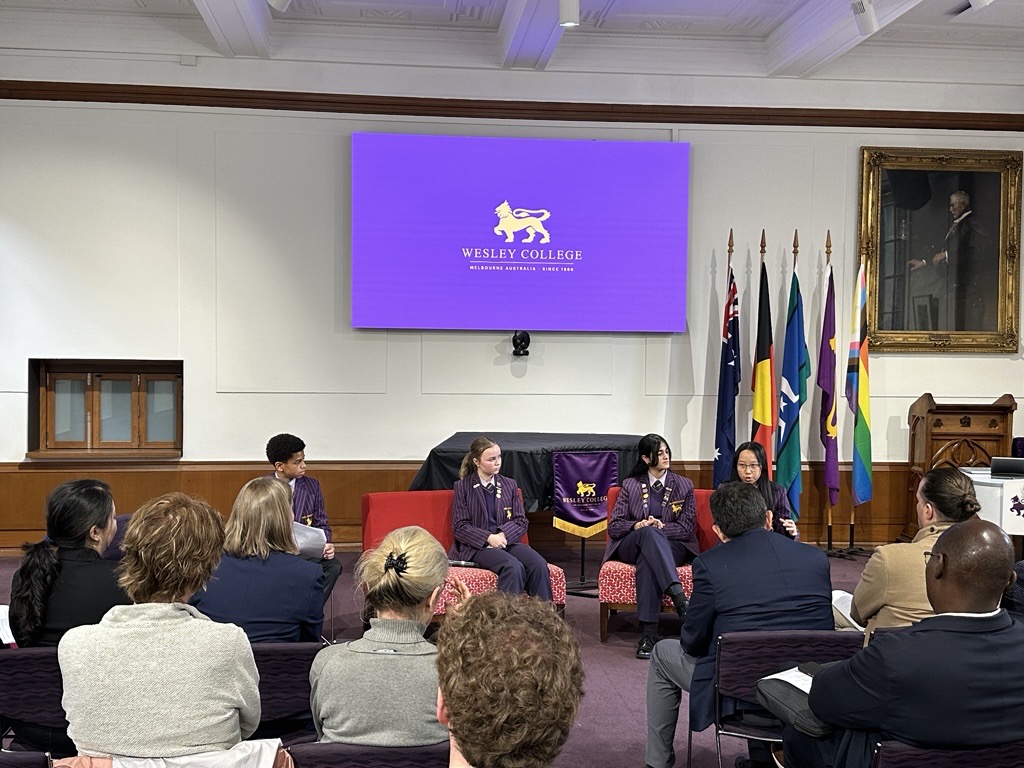
Wesley College was honoured to welcome senior leaders from the International Baccalaureate Organisation (IBO) during their recent visit to Australia, including former College Principal and IB Board Chair, Dr Helen Drennen AM and Director General, Olli-Pekka Heinonen.
As part of a national program exploring evidence-based education and the future of learning, the delegation visited Wesley to see firsthand how students and educators are bringing the IB framework to life through inquiry, collaboration and real-world learning experiences.
Wesley is one of a small number of schools in Australia to offer the full IB continuum from the Primary Years Program (PYP) through the Middle Years Program (MYP) to the Diploma Program (IB DP) meaning students develop as IB learners across their entire school journey. That depth of commitment was on full display during the visit.
What made the visit distinctive was that the entire session was student-led — from the presentations through to a Q&A with delegates at the end. The IBO's most senior leaders were, in effect, the audience.
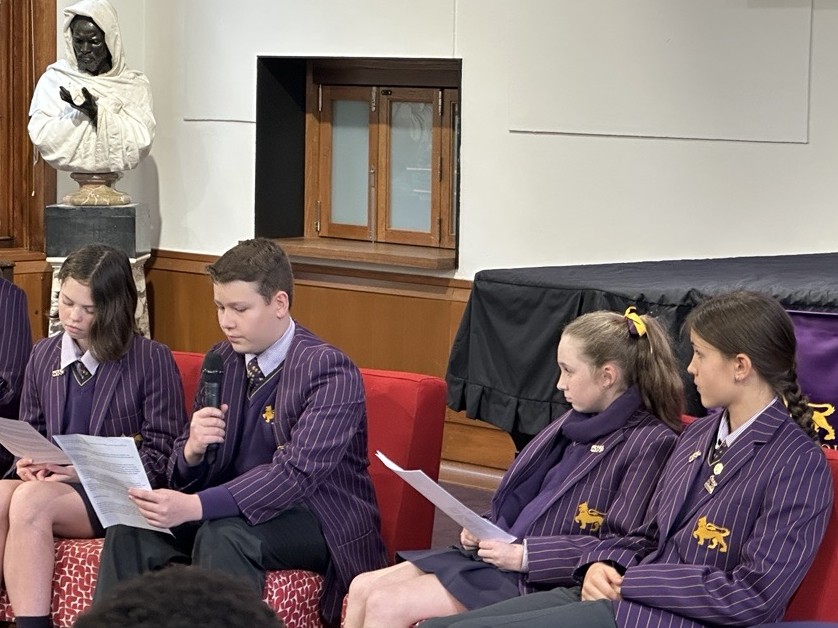
Year 7 students shared their learning from last year’s PYP Exhibition — the capstone inquiry experience of the PYP, which challenges students to demonstrate agency and take action on real world issues.
Izzy and Daniel, whose project focused on improving health outcomes for people in Africa, identified three key elements of student agency: acting with autonomy, engaging in open communication, and learning and practising new skills.
‘Creating meaningful change takes initiative and teamwork,’ Izzy reflected. ‘You can do the basics for a good outcome, but to get a great outcome, you need to go further - ask questions, listen to different perspectives and work together.’
Charlotte and Ellie, whose PYP Exhibition project focused on improving education in Nigeria, spoke about the importance of mindset. ‘Being open to new ideas and acting with courage were the most valuable things we learnt. This helped us face challenges with determination and positivity while staying focused on our goals.’
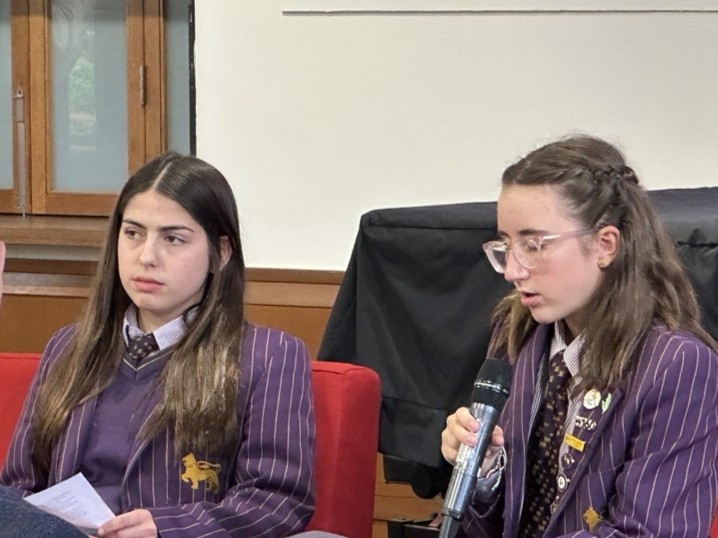 Delegates then heard from Year 9 students Hilary and Lila, who reflected on their time at Clunes, a residential experience where students live and learn within a local community for eight weeks and complete a PAC (Passion, Agency, Connect) project on a topic of their choice as part of the MYP.
‘My project explored the impact of pesticides on people and the surrounding environment,’ said Lila. ‘I focused on finding safe alternatives, researching, developing and testing three organic pesticide sprays to show there were other options available.’
Reflection drove her further than expected. ‘I was constantly asking myself, “What would improve my project?” and “Was it the best it could be?” Looking at myself through that lens helped push me further than I have ever done before,’ she said.
Lila also valued the independence the experience fostered. ‘Working independently allowed me to be creative and make my own decisions. I liked knowing the final result was entirely my responsibility.’
Hilary valued the freedom to pursue something personally meaningful. ‘I loved being able to choose a topic I actually cared about and connected with. Having the autonomy to take our projects in any direction we wanted also improved engagement as it was about something that mattered.’
‘Being independent and open to new experiences is definitely something the Clunes environment encourages,’ she said. ‘I tried to embrace every opportunity with enthusiasm and openness, even if it seemed scary or difficult at first, because that’s how you develop skills and grow as a person.’
If the delegation came looking for evidence of what IB learning can produce, they found it not in frameworks or data, but in the voices of students who have ownership of their learning, and the courage to share it.
We thank the IBO delegation for their time and their ongoing commitment to shaping education that asks our young people to think, question and lead.